Why Your Landing Pages Get Traffic but Still Don't Convert
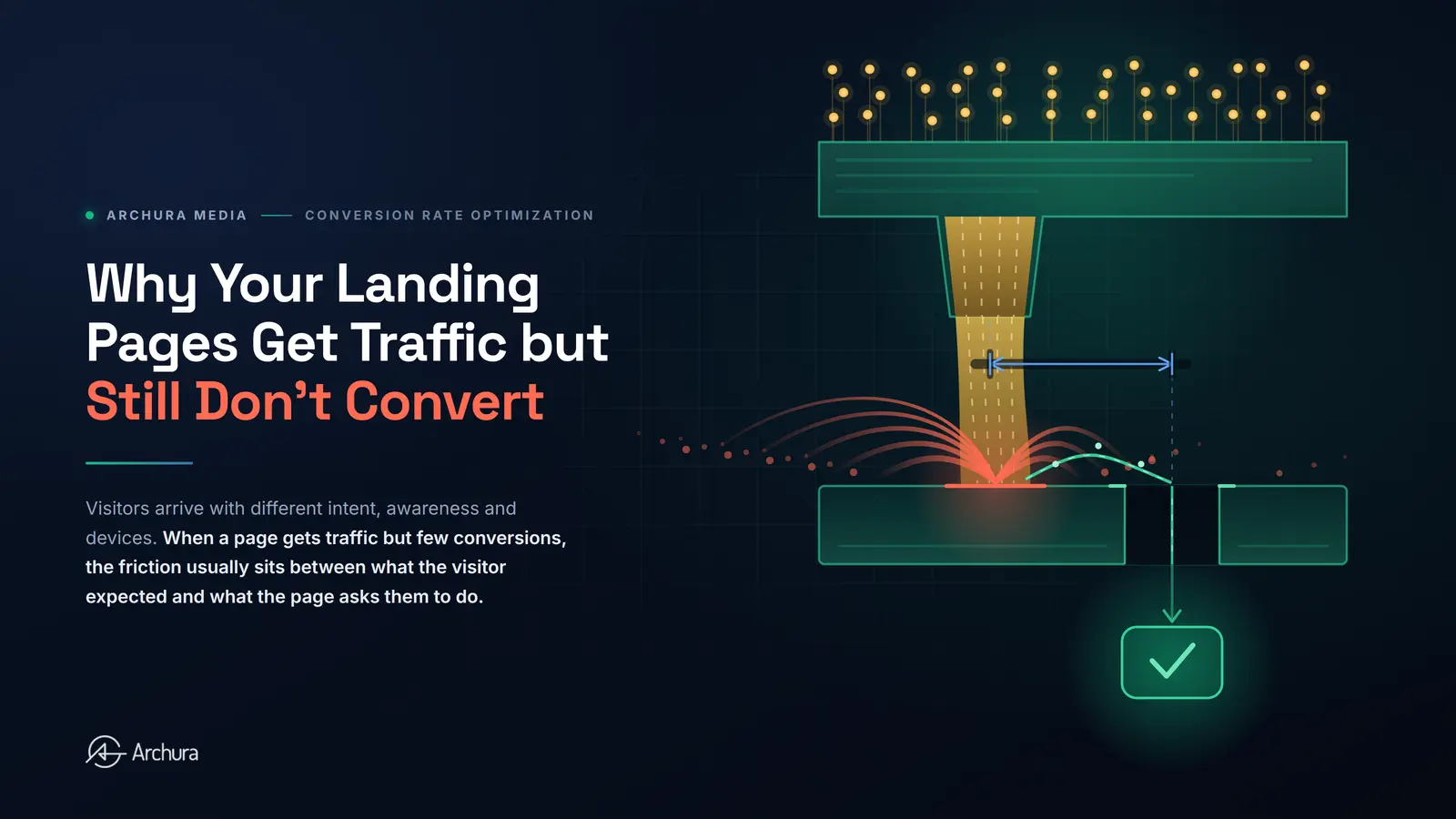
Traffic is only useful when visitors understand the offer, trust it, and know what to do next. A landing page can attract thousands of visits and still generate very few leads, registrations, or sales.
When that happens, the problem is usually not 'not enough traffic.' More often, the page creates friction between the visitor's intent and the action you want them to take. A strong landing page quickly confirms the visitor is in the right place, communicates a relevant benefit, and makes the next step feel easy.
Why Traffic Does Not Guarantee Conversions
Visitors arrive with different levels of awareness and intent. Someone searching for a specific service is different from someone who clicked a broad social ad. Mobile and desktop users may also behave differently.
Conversion rate depends on traffic quality, message match, user experience, trust, speed, and offer clarity. If traffic is healthy but conversions are weak, review the full journey rather than isolated design elements.
1. The Traffic Does Not Match the Offer
One of the most common causes of low conversion is intent mismatch. An ad may promise a free consultation while the landing page opens with a generic company introduction. A search query may be highly specific while the page covers several unrelated services.
Check what the visitor expected before clicking and whether the first screen continues that same message. Strong landing pages feel like a natural continuation of the keyword, ad, email, or referral source that brought the user there.
2. The Value Proposition Is Not Clear Enough
Visitors should understand the offer within seconds. If the headline is vague or focused on the company instead of the customer, users have to work too hard to understand why they should stay.
A strong value proposition answers three questions:
- What is this?
- Who is it for?
- What outcome does it help achieve?
'Powerful solutions for modern businesses' says very little. 'Find conversion blockers and turn more existing traffic into leads' is more specific. Clarity usually beats creativity on conversion-focused pages.
3. There Are Too Many Competing Actions
A landing page should have one clear primary goal. If users can book a call, download a guide, explore multiple services, subscribe, follow social accounts, and browse the full site from the same screen, attention becomes fragmented.
This does not mean every page must contain only one link. It means one next step should be dominant. Use one primary CTA and repeat it naturally where needed. Secondary actions should support the journey rather than compete with it.
4. The Page Does Not Build Enough Trust
Visitors are cautious when an action involves money, personal information, a sales conversation, or a meaningful commitment. Useful trust signals include:
- Client logos, testimonials, or reviews
- Case studies and specific proof of results
- Certifications, security, or compliance signals
- Clear contact information and transparent process details
Avoid unsupported claims such as 'best' or 'industry-leading' unless you can substantiate them. The closer a visitor gets to conversion, the more important proof becomes.
5. Mobile Experience Creates Friction
A page can look excellent on a large monitor and still fail on mobile. Common problems include slow loading, oversized hero sections, tiny buttons, long forms, intrusive pop-ups, dense text, and CTAs pushed too far down the page.
Review mobile as its own conversion journey. The first screen should communicate the offer clearly, actions should be easy to tap, and forms should require as little typing as possible.
6. The Form Asks for Too Much Too Soon
Every form field creates friction. A lead-generation page may not need company size, budget, phone number, job title, country, preferred service, and a detailed message before the visitor has received any value.
Ask only for the information required for the next step. If more qualification is necessary, collect it later or use a multi-step flow. If users start the form but frequently abandon it, the problem may be effort rather than interest.
7. The Page Is Slow or Technically Unreliable
Conversion problems are sometimes technical problems. A slow page, broken form, delayed script, incorrect mobile layout, or CTA that does not fire correctly can quietly reduce results while traffic appears normal.
Monitor page speed, Core Web Vitals, form submissions, button clicks, errors, thank-you pages, redirects, and analytics events. Small technical failures can affect every visitor until someone notices them.
8. The Copy Is About the Business, Not the Visitor
Many landing pages explain what the company does but not why it matters. Compare 'We provide advanced analytics and optimization services' with 'Find where users drop off, fix conversion blockers, and turn more existing traffic into leads.' The second version connects the service to an outcome.
Review each section and ask whether it helps the visitor make a decision. Features matter, but benefits, proof, and relevance usually do more to move someone toward action.
Landing Page Conversion Checklist
Area | What to Check | Warning Sign |
|---|---|---|
Traffic intent | Keywords, ads, referral sources | High traffic with weak engagement |
Message match | Headline and offer continuity | Visitors cannot quickly confirm relevance |
Value proposition | Outcome and differentiation | Generic or company-focused copy |
CTA hierarchy | Primary and secondary actions | Too many competing next steps |
Trust | Proof, reviews, credentials | Strong claims with little evidence |
Mobile UX | Layout, forms, CTA visibility | High mobile traffic and low conversion |
Forms | Fields and effort required | High form starts but low completions |
Technical setup | Speed, tracking, forms | Sudden drops or inconsistent data |
How to Improve a Landing Page That Is Not Converting
Do not rebuild everything at once. Start by identifying the biggest point of friction. Segment conversion performance by source and device, check whether the page matches the intent of your highest-value traffic, then review the headline, CTA, trust signals, mobile experience, form, and technical setup.
A useful order is:
- Fix technical failures.
- Remove irrelevant traffic.
- Improve message match.
- Clarify the value proposition.
- Simplify the CTA and form.
- Strengthen trust.
- Test meaningful variations.
This makes optimization evidence-based rather than subjective.
Final Takeaway
If a landing page gets traffic but does not convert, sending more visitors is rarely the first solution. Make the offer immediately clear, remove unnecessary decisions, build trust, simplify forms, optimize mobile performance, and verify that every technical step works.
Then measure the full conversion journey and test improvements one hypothesis at a time. The goal of CRO is not simply to make a page look better. It is to make it easier for the right visitor to understand the value, trust the offer, and take the next step.
FAQ
Why does my landing page get traffic but no conversions?
+The most common causes are poor traffic-to-offer alignment, unclear messaging, weak trust signals, competing actions, form friction, mobile usability problems, or technical issues.
Should a landing page have only one CTA?
+It should usually have one primary conversion goal. The CTA can appear multiple times, while secondary actions should support rather than distract from that goal.
How do I know what is hurting my conversion rate?
+Segment performance by traffic source and device, then review CTA clicks, form starts, completions, exits, and technical errors. Heatmaps and session recordings can add useful context.