How iGaming Brands Lose Branded Traffic to Affiliates
Branded traffic should be the easiest traffic an iGaming operator owns.
When a player searches for your casino or sportsbook by name, they already know you. They are not casually browsing. They may be trying to register, log in, claim a bonus, download your app, or return after seeing an ad.
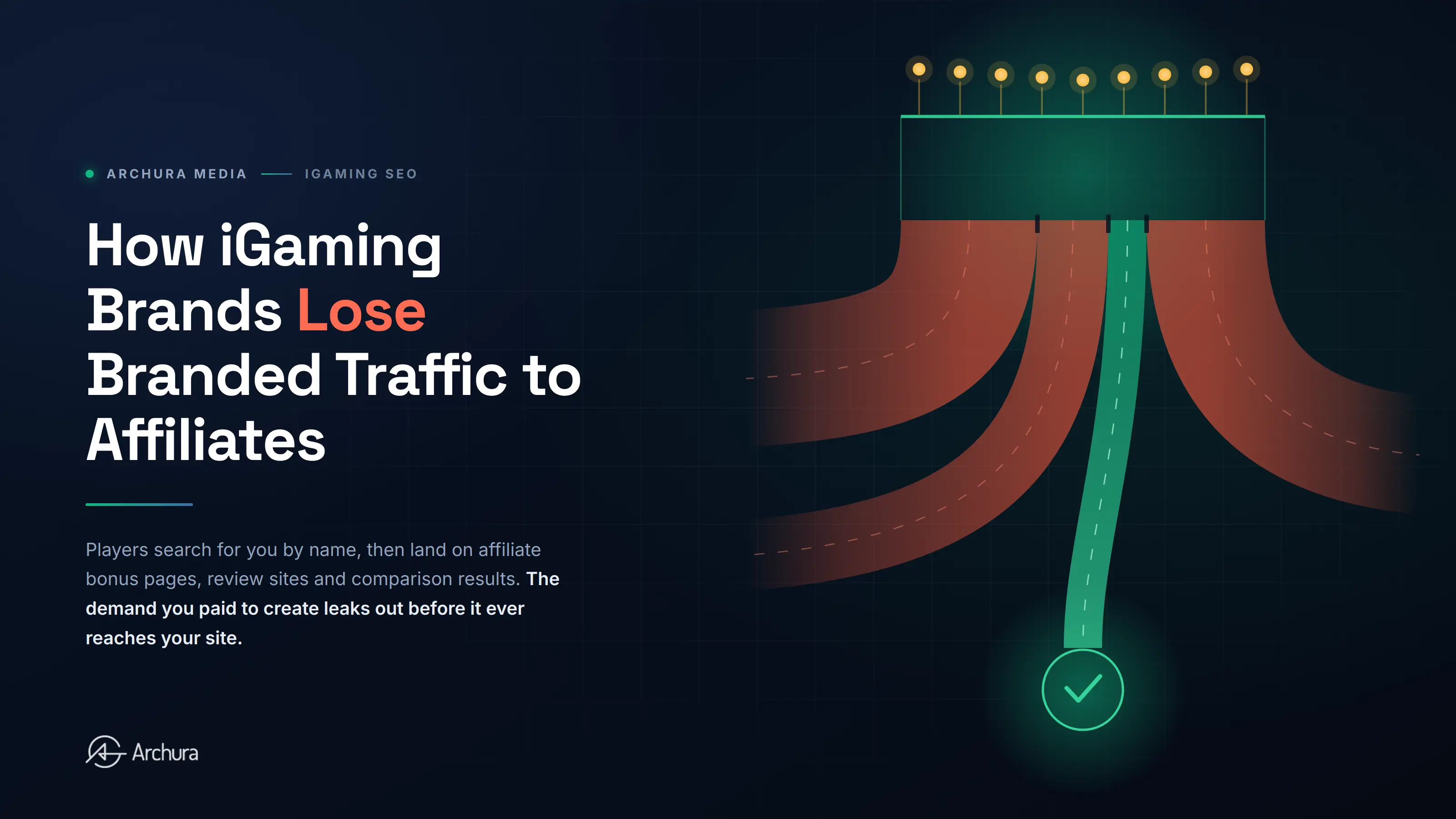
That makes branded search one of the highest-intent acquisition channels in iGaming. But many operators lose a surprising amount of this traffic before it ever reaches their website.
Instead of clicking the official brand result, users end up on affiliate pages, bonus comparison sites, review pages, outdated landing pages, mirror domains, fake login pages, or competitor-controlled content.
The result is simple: you pay more to acquire users who were already looking for you. That is where brand protection SEO becomes critical.
What Is Branded Traffic in iGaming?
Branded traffic is search demand that includes your brand name.
For example:
- [brand name] casino
- [brand name] sportsbook
- [brand name] bonus
- [brand name] login
- [brand name] app
- [brand name] promo code
- [brand name] withdrawal
- [brand name] review
- [brand name] alternative
- [brand name] not working
In iGaming, these searches are extremely valuable because they often sit close to conversion.
A user searching for “brand bonus” may be ready to deposit.
A user searching for “brand login” may already be an active player.
A user searching for “brand app download” may be ready to install.
A user searching for “brand review” may be one reassurance away from registering.
If affiliates, review sites or competitors dominate these results, your brand loses control over the player journey.
Why Branded Search Matters More in iGaming Than in Many Other Industries
In normal ecommerce, a branded search usually leads directly to the official website. In iGaming, the SERP is often much more aggressive.
Casino and sportsbook results can include:
- Affiliate bonus pages
- Review sites
- “Best casino” comparison pages
- Promo code pages
- Mirror sites
- Login guides
- App download pages
- Forum discussions
- Competitor ads
- Fake or phishing pages
- Country-specific landing pages
- News articles
- User complaint pages
This creates a messy search environment around your brand. Even when players search for you directly, they are still exposed to other businesses trying to intercept the click. That means branded search is not just an SEO issue. It affects acquisition cost, player trust, conversion rate, affiliate spend, retention and brand safety.
How Affiliates Capture Your Branded Traffic
Affiliates usually do not need to outrank you for your homepage query to create damage. They only need to rank for high-intent variations around your brand.
Here are the most common ways it happens.
1. They Rank for “[Brand] Bonus” Searches
Bonus-related searches are some of the most commercially valuable branded queries.
Examples:
- [brand] bonus
- [brand] welcome bonus
- [brand] free spins
- [brand] promo code
- [brand] no deposit bonus
- [brand] bonus terms
If your official bonus page is weak, thin, slow, uncrawlable or missing clear structured content, affiliates can rank above or around you with pages built specifically for those queries.
This is expensive because the player already searched for your brand. But if the user clicks an affiliate page first, you may end up paying commission for a player you could have acquired directly.
2. They Create Better Landing Pages Than the Operator
A lot of iGaming brands lose branded clicks because the affiliate page is simply more useful than the official page.
The affiliate page may have:
- A clearer bonus summary
- Better headings
- Faster load speed
- Cleaner mobile UX
- FAQ sections
- Payment method details
- Country-specific information
- App download instructions
- Registration steps
- Updated screenshots
- Bonus terms explained in plain language
Meanwhile, the operator’s official page may be generic, slow, hard to read, or not optimized for the exact search intent. This is a brutal truth: if an affiliate explains your offer better than you do, search engines and users may reward them.
3. They Target “Review” and “Is It Legit?” Queries
Many players search for reassurance before depositing.
Examples:
- [brand] review
- is [brand] legit
- is [brand] safe
- [brand] complaints
- [brand] withdrawal time
- [brand] trustpilot
- [brand] license
If the operator has no strong content for these queries, affiliates and review sites control the narrative. That is risky because the user may see outdated information, incorrect bonus terms, exaggerated negatives, or competitor recommendations. The problem is not only losing the click. The bigger issue is losing trust at the exact moment the player is deciding whether to deposit.
4. They Capture Login and App Searches
Some branded searches are not acquisition searches. They are active-user searches.
Examples:
- [brand] login
- [brand] casino login
- [brand] app
- [brand] app download
- [brand] Android app
- [brand] iOS app
- [brand] mobile
If affiliates or unofficial pages rank for these terms, the player journey becomes unnecessarily risky. Users may land on outdated instructions, broken app links, irrelevant bonus pages, or unsafe third-party pages. For operators, this can affect more than acquisition. It can create customer support issues, lower repeat visits, reduce app installs, and expose users to phishing risk.
5. They Benefit From Weak Technical SEO
Affiliates often win branded visibility because operators leave basic SEO problems unresolved.
Common issues include:
- Missing or duplicate meta titles
- Poor internal linking
- Weak category structure
- Slow page speed
- Indexing problems
- Canonical mistakes
- Blocked pages in robots.txt
- Broken bonus pages
- Redirect chains
- Outdated sitemaps
- Thin localized pages
- Missing FAQ schema
- Poor mobile usability
In iGaming, small technical issues can become expensive because the SERP is so competitive. If your official pages are not easy to crawl, index, understand and rank, someone else will fill the gap.
6. They Build Content Around Every Brand Query You Ignore
Affiliates are usually very good at long-tail SEO.
They create pages for every variation users search:
- [brand] withdrawal limit
- [brand] payment methods
- [brand] minimum deposit
- [brand] verification
- [brand] KYC
- [brand] VIP program
- [brand] odds boost
- [brand] casino games
- [brand] live casino
- [brand] sportsbook bonus
- [brand] not working
- [brand] alternatives
Most operators only optimize the homepage, bonus page and maybe one or two product pages. That leaves dozens or hundreds of branded search variations open. Each one may look small individually. Together, they can represent meaningful traffic, registrations, deposits and support-sensitive journeys.
7. They Use Your Brand to Recommend Competitors
This is one of the most damaging cases.
A player searches for your brand and lands on an affiliate page titled something like:
- “[Brand] Review: Is It Worth It?”
- “[Brand] Bonus Code”
- “[Brand] Alternatives”
- “[Brand] vs Competitor”
- “Best Sites Like [Brand]”
The page may include your offer, but it may also promote several competitors with higher commissions or better affiliate deals. So the user began with your brand but ended up comparing you against alternatives. That is branded demand leaking into competitor acquisition.
What This Costs iGaming Operators
Losing branded traffic is not just an SEO inconvenience.
It can create direct commercial damage across the acquisition funnel.
Higher CPA and FTD Costs
If users who already searched for your brand enter through affiliate links, you may pay commission on traffic that should have been direct. This inflates acquisition cost and makes performance look worse than it should be.
Lower Conversion Rate
Affiliate pages add another step between the player and your registration page. Every extra click creates friction. Some users drop off. Some get distracted. Some choose another brand.
Weaker Brand Control
When third-party pages dominate branded SERPs, the operator loses control over messaging, offers, terms, screenshots, trust signals and user expectations.
Increased Support Issues
If users find outdated login links, incorrect app instructions or old bonus terms, support teams deal with the confusion.
Higher Phishing and Brand Safety Risk
In some markets, fake or unofficial pages can appear around brand searches. This creates risk for both users and the operator’s reputation.
Lost Revenue From High-Intent Players
The biggest cost is opportunity loss.
Branded search users are usually warmer than generic search users. Losing even a small percentage of this demand can affect registrations, FTDs, deposits and lifetime value.
Warning Signs You Are Losing Branded Traffic
Here are signs your brand search visibility may be leaking:
- Affiliate pages rank in the top results for your brand + bonus queries
- Review sites outrank your official pages for trust and review searches
- Your bonus pages are not ranking for your own bonus terms
- Search Console shows branded impressions but weak CTR
- Competitors appear on “alternative” or “review” searches
- Your homepage ranks, but deeper official pages do not
- Old campaign pages are still indexed
- Localized branded SERPs are controlled by third parties
- Your app or login searches show unofficial pages
- Branded paid search CPCs are increasing
- Users ask support about outdated offers found on Google
If several of these are happening, branded search protection should be treated as a revenue project, not a minor SEO task.
How to Protect Branded Traffic From Affiliates
The goal is not to remove every affiliate from search results. In iGaming, affiliates can still be valuable acquisition partners. The goal is to make sure your official brand assets dominate the searches that should belong to you.
1. Audit Your Branded SERPs
Start by mapping the search results around your brand.
Check queries like:
- [brand]
- [brand] casino
- [brand] sportsbook
- [brand] bonus
- [brand] promo code
- [brand] review
- [brand] login
- [brand] app
- [brand] withdrawal
- [brand] payment methods
- [brand] complaints
- [brand] alternatives
Do this across your key markets and languages.
The branded SERP in one country may look completely different from another. A brand may be protected in its home market but heavily exposed in expansion markets.
2. Build Official Pages for High-Intent Brand Queries
If users search for something important, you should have an official page that answers it clearly.
Important pages may include:
- Official bonus page
- Welcome offer page
- Promo code page
- Login help page
- App download page
- Payment methods page
- Withdrawal guide
- Responsible gaming page
- Verification/KYC guide
- VIP or loyalty page
- Sportsbook features page
- Casino games page
- Review-style trust page
- Country-specific landing pages
These pages should not be thin placeholders. They need to be fast, mobile-friendly, internally linked, crawlable, and written in a way that directly answers the query.
3. Improve Titles, Meta Descriptions and Headings
For branded queries, clarity matters.
A page title like: Welcome Bonus | Brand Name
is weaker than: Brand Name Welcome Bonus: Official Casino Offer & Terms
The second version is clearer, more specific, and better aligned with branded search intent.
Meta descriptions should also make it obvious that the page is official.
Example: Claim the official Brand Name welcome bonus. View current offer details, eligibility, payment methods and key terms before registering.
This helps search engines understand the page and gives users confidence before clicking.
4. Add FAQ Sections for Long-Tail Queries
FAQ content is useful for both SEO and AI search visibility.
Add concise answers to questions like:
- What is the official Brand bonus?
- Does Brand have a mobile app?
- How long do withdrawals take?
- What payment methods does Brand support?
- Is Brand licensed?
- How do I contact Brand support?
- What are the bonus wagering requirements?
Keep the answers clear and factual. For AI search, direct question-and-answer formatting helps systems extract useful information from the page.
5. Strengthen Internal Linking
Your homepage alone cannot protect the entire branded search landscape. You need strong internal links to your important branded pages.
For example:
- Link from homepage to bonus, app, payments and support pages
- Link from bonus page to terms, registration and payment methods
- Link from app page to login, install instructions and support
- Link from review/trust page to license, responsible gaming and withdrawals
- Link localized pages to relevant country-specific offers
Internal linking helps search engines understand which pages matter and how they connect.
6. Keep Offers and Terms Updated
Outdated bonus information is one of the easiest ways to lose trust. If affiliates update faster than your official site, they can become more useful to users.
Make sure your official pages always show:
- Current bonus amount
- Valid promo codes, if applicable
- Wagering requirements
- Minimum deposit
- Eligible markets
- Expiry dates
- Game restrictions
- Payment restrictions
- Full terms link
This is especially important for AI search because outdated or contradictory information can reduce confidence in your content.
7. Monitor Technical SEO Daily
Branded traffic protection is not a one-time project. You need to catch problems before they affect rankings or users.
Monitor:
- Indexing status
- Robots.txt changes
- Canonical tags
- Redirects
- Broken links
- Metadata changes
- Page speed
- Sitemap issues
- HTTP status codes
- Content changes
- Internal link changes
- AMP or mobile issues, where relevant
For iGaming brands, technical issues can become revenue issues very quickly. A broken bonus page, incorrect canonical, or blocked app page can push users toward affiliates overnight.
8. Localize Brand Protection by Market
A single English page will not protect your brand across every market. For multilingual or multi-market operators, create localized assets around branded intent.
Examples:
- Local bonus pages
- Local payment method pages
- Local trust and license explanations
- Local app download instructions
- Local responsible gaming pages
- Local customer support information
- Market-specific FAQs
This matters because affiliates often target markets where the operator’s official content is weak or missing. If you operate in multiple languages, brand protection needs to be multilingual too.
9. Track Branded CTR and Conversion Impact
Do not only track rankings. Track business impact.
Useful metrics include:
- Branded impressions
- Branded clicks
- Branded CTR
- Rankings for brand + bonus queries
- Rankings for brand + review queries
- Organic registrations
- Organic FTDs
- Organic conversion rate
- Assisted conversions
- Paid branded CPC
- Affiliate commission from branded queries
- Support tickets related to login, bonus or app confusion
The goal is not just to “rank better.” The goal is to recover traffic, reduce leakage, improve conversion and lower unnecessary acquisition cost.
10. Align SEO, Affiliate and Compliance Teams
Brand protection works best when teams are not isolated.
SEO should know which affiliates are ranking on branded terms.
Affiliate managers should know which partners are bidding or ranking aggressively.
Compliance should know when third-party pages use outdated or misleading terms.
Product and development teams should know which official pages need technical fixes.
Without alignment, one team may be paying affiliates for traffic that another team is trying to recover through SEO.
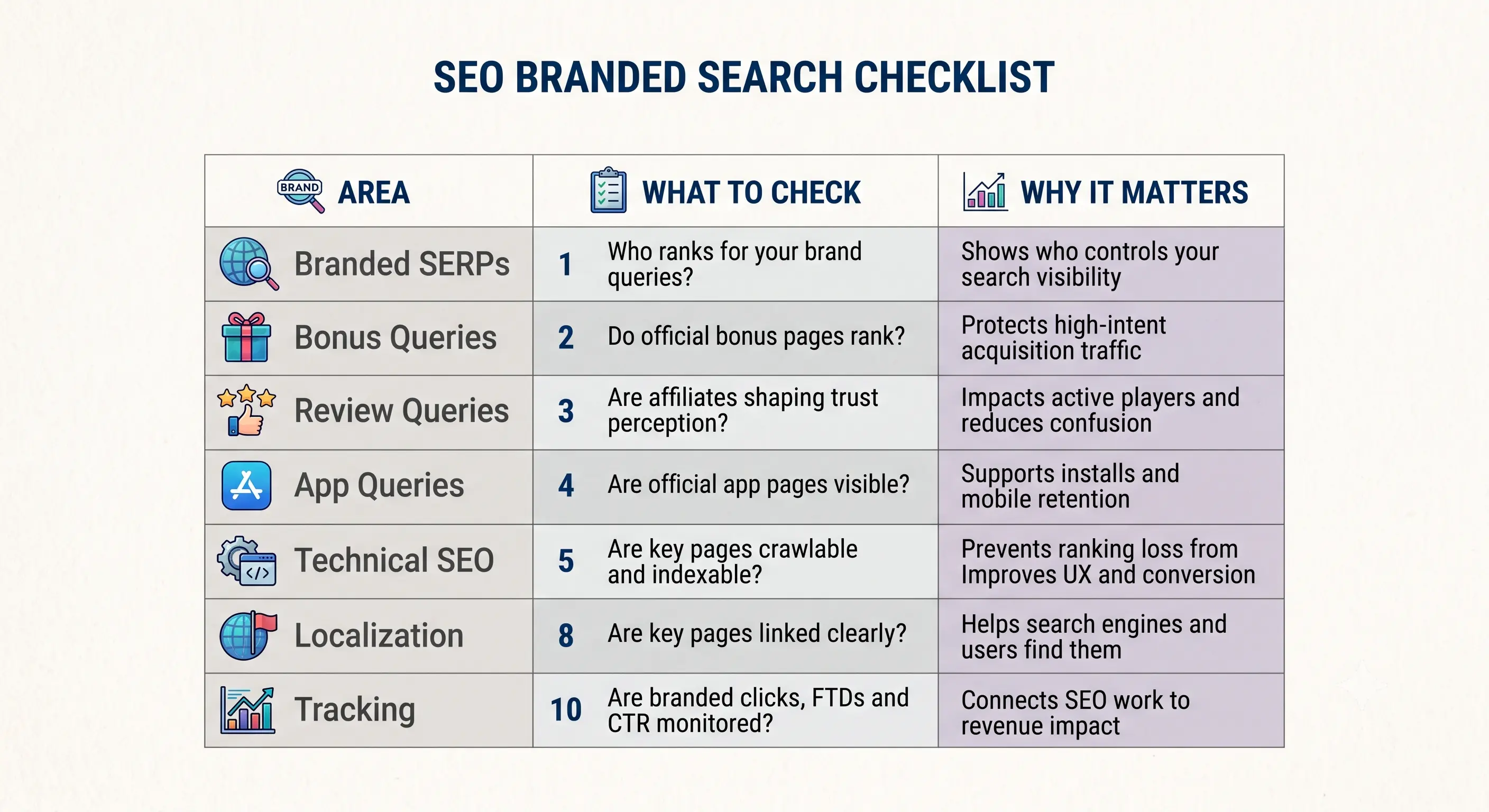
Use this checklist to identify where your branded traffic may be leaking.
The Strategic Point: Own the Demand You Created
iGaming brands spend heavily on awareness, sponsorships, affiliates, paid search, SEO, social media, influencers and retention campaigns. All of that activity creates brand demand. But if players search for your brand and land somewhere else, you are not fully capturing the demand you paid to create. That is the core problem.
Brand protection SEO is not about vanity rankings. It is about defending high-intent traffic, reducing unnecessary affiliate dependency, improving player trust, and making sure official pages are the clearest and safest destination in search.
Final Takeaway
iGaming brands lose branded traffic when they leave search gaps around their own name. Affiliates and competitors take advantage of weak bonus pages, missing review content, poor technical SEO, slow landing pages, outdated information, and unprotected localized SERPs. To fix it, operators need to treat branded search as a commercial asset. That means auditing branded SERPs, building official pages for high-intent queries, improving technical SEO, adding clear FAQs, localizing by market, tracking conversion impact, and monitoring issues continuously.
The brands that win are not always the ones with the biggest acquisition budgets. They are the ones that protect the demand they already earned.
FAQ
What is branded traffic in iGaming?
+Branded traffic is search traffic that includes the name of a casino, sportsbook or iGaming brand. Examples include searches for brand bonuses, login pages, app downloads, reviews, payment methods and promo codes.
Why do affiliates rank for iGaming brand searches?
+Affiliates often rank because they create highly targeted pages for branded keywords such as bonus, review, promo code, app and alternatives. If the operator does not have strong official pages for those searches, affiliates can capture the traffic.
Is affiliate traffic bad for iGaming brands?
+Not always. Affiliates can be valuable acquisition partners. The issue is when affiliates capture users who were already searching for the brand directly. In that case, the operator may pay commission for traffic it could have acquired through its own official pages.
How can iGaming brands reduce branded traffic leakage?
+Brands can reduce leakage by auditing branded SERPs, creating official pages for high-intent queries, improving technical SEO, using clear metadata, adding FAQs, strengthening internal links, localizing content and monitoring rankings daily.
What branded keywords should casino and sportsbook operators monitor?
+Operators should monitor queries such as brand name, brand bonus, brand promo code, brand review, brand login, brand app, brand withdrawal, brand payment methods, brand complaints and brand alternatives.
Does brand protection SEO reduce CPA?
+It can. When a brand captures more direct branded traffic through official search results, it may reduce unnecessary reliance on paid clicks or affiliate commissions for users who were already looking for the brand.