How to Optimize Your Website for AI Search Results
Customers discover businesses through Google, Bing, ChatGPT, Perplexity and Claude. Some answers cite sources; others summarize without sending clicks. Visibility is changing, but traditional SEO still matters.
AI search optimization makes content more accessible and useful as a source. The goal is qualified discovery, not tricking a model into mentioning your brand.
What Is AI Search Optimization?
AI search optimization, also called generative engine optimization (GEO) or answer engine optimization (AEO), improves how search-connected AI systems can find, interpret and cite web content. Different platforms use different indexes, crawlers and retrieval methods.
There is no universal “LLM ranking.” One assistant may cite a page that another overlooks. Focus on useful answers, verifiable information and business results.
1. Check Crawl Access Across AI Search Platforms
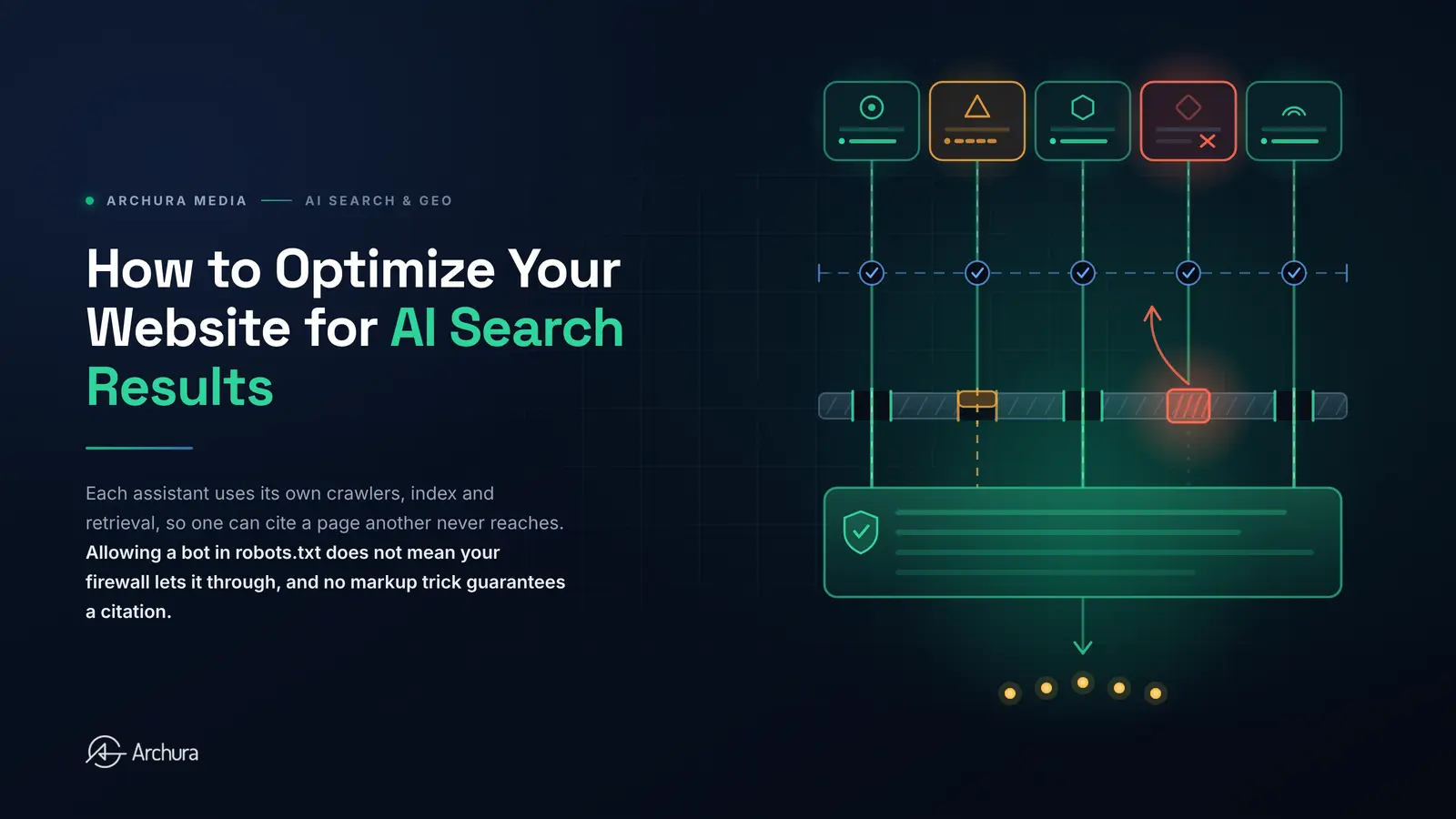
Check robots.txt, indexing, canonicals, errors, login walls, JavaScript rendering and firewalls. A crawler allowed by robots.txt may still be blocked by a CDN.
Search-related bots differ from training crawlers. Google AI features rely on normal Google Search eligibility; ChatGPT uses OAI-SearchBot; Perplexity documents PerplexityBot; and Anthropic distinguishes Claude-SearchBot from ClaudeBot, its training crawler. Bing indexing also matters for Microsoft Copilot. Review official policies before changing access.
• Test whether priority pages return usable content to Googlebot, Bingbot and relevant AI search crawlers.
• Verify bot access through server/WAF logs, not only robots.txt; check 403s, CAPTCHAs and redirects.
• Keep canonical URLs, XML sitemaps, internal links and visible page text consistent.
2. Answer Real Customer Questions Clearly
Start with a real customer question. Explain the problem, trade-offs and next steps. A direct answer helps readers without turning the page into artificial “AI chunks.”
For example, software buyers may ask about integrations and security; shoppers may compare returns and warranties; an iGaming operator may need market-specific information about registration or product features. One useful page can address several related questions naturally.
Use descriptive headings, readable paragraphs, honest comparisons and FAQs when they serve real users. Google explicitly says there is no required content length or special chunk size for its AI search features.
3. Publish Information AI Cannot Find Everywhere Else
Original tests, product documentation, methodology, real examples and carefully sourced data distinguish your page from generic summaries.
Explain where information came from and when it was checked. Keep prices, restrictions, product capabilities and market rules current. Do not manufacture statistics, testimonials or “expert” quotes to make a page look more credible.
For multilingual websites, research the actual questions people ask in each market. Translate the expertise, not just the words, and keep local eligibility, terminology and offers accurate.
4. Make Your Brand and Expertise Easy to Verify
State what your business does, who it serves and how to contact it. Keep facts consistent across your site and credible external profiles.
Use genuine authors, truthful credentials and verifiable case studies. Authentic mentions aid discovery; fabricated citations and artificial mentions are not shortcuts.
Link related guides to relevant services and product pages. This helps users move from general questions to useful details while establishing a coherent subject structure.
5. Use Traditional Schema, Not a Fictional “AI Schema”
Structured data such as Organization, WebSite, BlogPosting or Article, BreadcrumbList and relevant Service markup can describe real page information. It should agree with what visitors can actually see. Bing also recognizes accurate structured data as one signal that can clarify content for search and grounding.
No universal “AI schema” guarantees citations. Google requires no extra markup for AI Overviews or AI Mode and retired FAQ rich results in 2026. FAQPage markup is not a visibility switch.
6. Treat llms.txt and GEO “Hacks” as Experiments
The llms.txt proposal offers agents a curated Markdown guide to important pages. Some documentation platforms and agents use it, especially for technical documentation. But adoption does not prove a ranking benefit in consumer AI search. Google explicitly ignores llms.txt for ranking and inclusion, and no general citation advantage is verified across ChatGPT, Perplexity, Claude or Copilot.
Test llms.txt for developer documentation or agent workflows, checking whether agents fetch it. Do not prioritize it over crawlability, content or measurement. Avoid artificial mentions, forced “AI keywords,” hidden prompts and arbitrary chunking.
7. Measure AI Citations and Commercial Outcomes
Use Google Search Console’s generative-AI reporting and Bing Webmaster Tools’ AI Performance reports for citations and grounding queries. Review referrals too; ChatGPT links may include utm_source=chatgpt.com.
Test consistent customer questions across assistants. Record citations, URLs, accuracy and markets. Answers vary, so repeated prompt checks indicate patterns, not stable rankings.
Most importantly, connect visibility to qualified visits, enquiries, registrations and revenue. A hundred irrelevant mentions are less valuable than one accurate citation that helps the right visitor make a decision.
AI Search Optimization Checklist
Area | Action | What to verify |
|---|---|---|
Access | Check Google, Bing and AI search bots | Pages load without WAF blocks |
Content | Answer relevant buyer questions | Direct answer plus useful evidence |
Originality | Publish first-hand information | Unique examples, research or tests |
Trust | Verify authors and business details | No invented credentials or mentions |
Markup | Validate conventional schema | Matches visible on-page content |
llms.txt | Optional agent-friendly pilot | Not treated as a ranking signal |
Measurement | Track citations and conversions | AI visibility tied to outcomes |
A Simple 30-Day Action Plan
Week 1: Audit important pages, indexing and crawler/WAF access across platforms. Week 2: Improve ten high-intent questions with original examples and accurate facts. Week 3: Validate schema, brand identity and internal links; optionally pilot llms.txt. Week 4: Review Google/Bing AI reporting, referral conversions and repeatable prompt checks.
Do not use the month to mass-produce near-duplicate pages or purchase fake brand mentions. Measure whether each improvement helps real visitors.
Frequently Asked Questions
Is GEO different from traditional SEO?
+They overlap heavily. GEO focuses on being discovered or cited in generated answers; SEO covers broader organic visibility. Crawl access, unique content and credibility support both, although citation systems differ by platform.
Do I need an AI schema or llms.txt file?
+No universal AI-specific schema is required. Google does not use llms.txt for search rankings, and the major AI search platforms have not documented it as a citation-ranking requirement. Traditional schema remains useful; llms.txt is optional for agents that explicitly support it.
Do all AI search engines use the same crawler?
+No. Google, Bing, OpenAI, Perplexity and Anthropic document different search-related crawlers and access controls. Allowing an AI training crawler is not the same as allowing search discovery. Check each provider’s documentation and your security logs.
How can I see whether ChatGPT sends traffic to my website?
+Review referrals and campaign tags in analytics. ChatGPT search links may include utm_source=chatgpt.com. Look beyond sessions to engagement, lead quality and conversions.
Turn AI Search Visibility Into Qualified Growth
AI search optimization is not one secret file, prompt or markup trick. Strong pages are accessible, clear, original and trustworthy. Then measure whether those pages are actually used in answers—and whether useful business outcomes follow.
Archura Media brings together technical SEO, content strategy and performance measurement to help businesses turn changing discovery patterns into measurable growth. Start with an audit of your most valuable pages and build from the strongest opportunities.