How to Protect Your iGaming Brand From SERP Competitors
How to Protect Your iGaming Brand From SERP Competitors
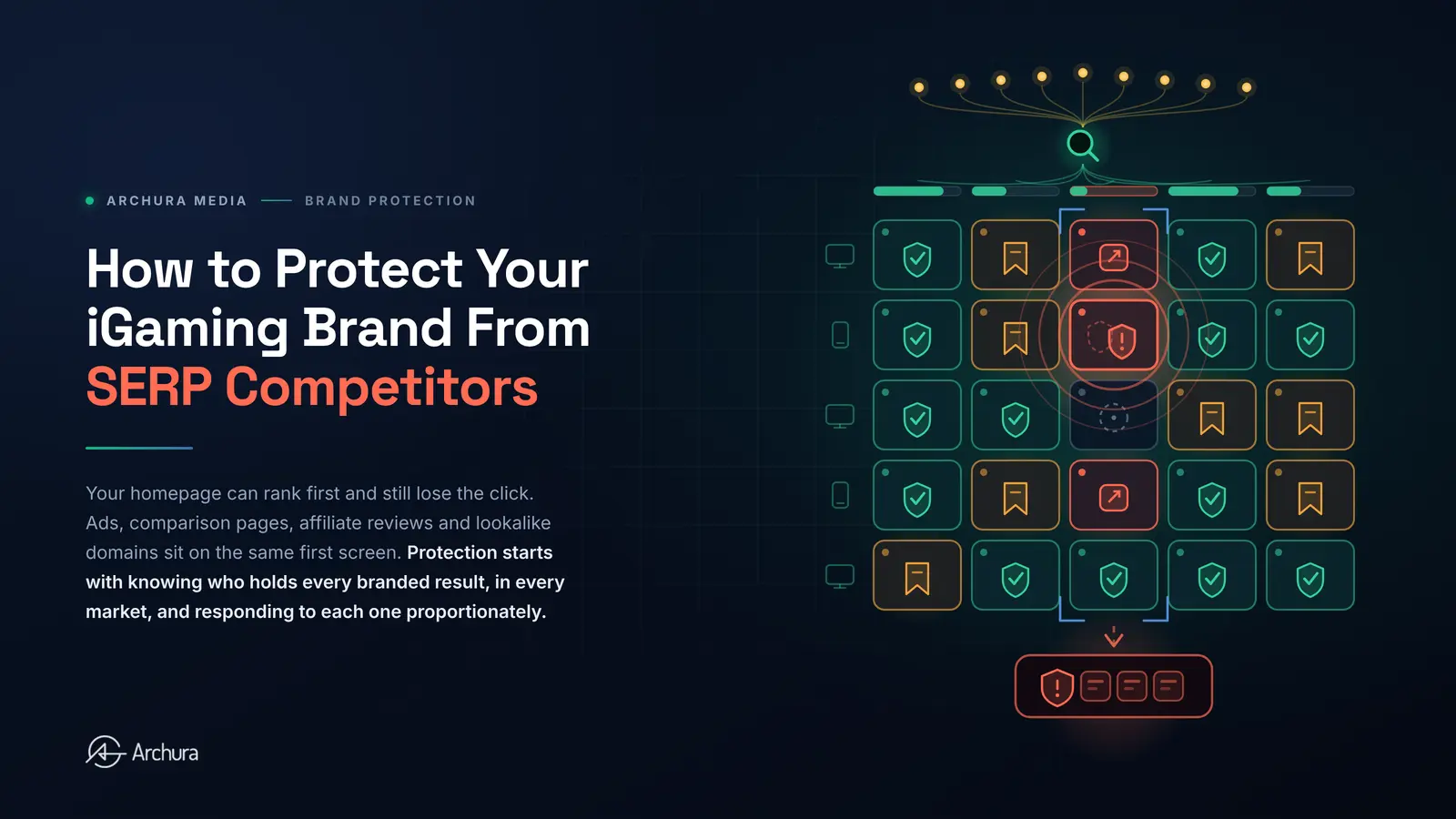
A player searches for your sportsbook by name. The first screen shows a competitor’s advertisement, a comparison website, and an unfamiliar domain that looks official. Your homepage may still rank first organically, yet the player has several opportunities to leave before clicking it.
That is a search engine results page (SERP) protection problem. For casino and sportsbook operators, protecting branded visibility means tracking who appears around your name, identifying genuine risks, and making official information the easiest information to find.
What Are SERP Competitors in iGaming?
SERP competitors are websites or advertisers competing for attention on searches related to your brand. They are not always direct business rivals. An affiliate review, a bonus directory, a search advertisement, a comparison page, or an impersonating domain can all influence where a player goes next.
A legitimate review is different from a fraudulent login page. The objective is not to remove every third-party mention; it is to understand who controls each search result and respond proportionately.
Which Branded Search Results Deserve Attention?
Start with searches where confusion or lost intent is most costly: brand name, login, app, bonus, promo code, withdrawal, review, complaints, and “[brand] alternatives.” Include common misspellings and country-language variations.
Examine more than traditional organic listings. Record sponsored results, prominent SERP features, AI-generated summaries where present, and the actual destination URL behind each result. Mobile and desktop layouts can differ substantially.
How to Protect Your Brand: An Eight-Step Process
1. Build a Market-Specific SERP Inventory
Create a keyword list for each priority country and language. Check the same queries on mobile and desktop, then record the top visible domains, their positions, result types, and landing pages. Save dated screenshots so you can compare changes rather than relying on memory.
Prioritize markets generating registrations and first-time deposits (FTDs). A new competitor result in a high-value market deserves attention before a low-volume informational mention.
2. Classify the Threat Before Acting
Group findings into direct competitors, affiliates, independent publishers, obsolete pages, and potential impersonation. Note whether a result is merely critical, commercially competitive, misleading, or apparently fraudulent. This distinction determines whether the appropriate response is SEO improvement, partner management, a factual correction, or escalation.
3. Strengthen Your Official Search Footprint
Make official brand pages clear and technically reliable. Maintain accessible pages for login help, the app, promotions, payments, withdrawals, support, licensing, and responsible gaming. Use descriptive page titles, consistent naming, current offer terms, sensible internal links, and correct canonicals.
Where helpful, add concise answers to common questions. Ensure important content is visible to crawlers rather than hidden behind login screens or client-side rendering failures.
4. Match the Intent Behind Each Query
A homepage cannot satisfy every branded search. Someone looking for withdrawal rules needs an accurate payments explanation; someone looking for a mobile app needs the official download path. Build useful pages for those intents instead of creating dozens of near-duplicate keyword variations.
This also helps players recognize the official destination without depending on a promotional claim such as “best bonus.”
5. Coordinate Affiliate and Paid-Search Oversight
Review whether partners use outdated offers, misleading snippets, confusing domains, or restricted brand bidding. Compare discoveries against affiliate agreements and advertising-platform policies. Coordinate SEO, affiliate, paid media, and compliance teams before contacting a publisher or changing bidding strategy.
Keep legitimate comparison coverage separate from conduct that breaches a contract or impersonates the operator.
6. Monitor Local SERPs and New Domains
An English-language check can miss a local threat entirely. Monitor country-specific brand spellings, local bonus terminology, and regional payment queries. Add alerts for newly registered lookalike domains and changes to existing third-party pages, then verify suspected matches manually.
7. Escalate Impersonation With Evidence
If a result appears to mimic your identity or direct users to a suspicious login, preserve the URL, screenshot, timestamp, query, and target country. Route it to security and legal teams. Where appropriate, report phishing to the platform, browser-safe-browsing service, registrar, or hosting provider.
Do not assume that an unfavorable review is removable. Google provides distinct reporting routes for spam and phishing, and submission does not guarantee a result will disappear.
8. Measure Business Impact, Not Just Rankings
Track official-result visibility, branded organic clicks and click-through rate in Search Console, competitor presence in priority SERPs, brand-ad costs, and downstream registrations and FTDs. Compare by country, device, and query group. Ranking screenshots diagnose exposure; conversion data indicates whether fixing it is commercially worthwhile.
Daily SERP Protection Checklist
Check | What to look for | Response |
|---|---|---|
Top branded queries | New ads or non-official results | Record and assess intent |
Login and app searches | Unexpected domains or redirects | Verify and escalate risk |
Bonus and review searches | Outdated terms or competitor offers | Update pages; contact partners |
Local markets | New language-specific pages | Compare by market and device |
Official page health | Broken URLs, noindex, wrong canonical | Fix technical issue promptly |
Performance | CTR, clicks, registrations, FTDs | Prioritize material losses |
What About AI Search Results?
AI-assisted search can summarize brands using information from official sites and third parties. Keep licensing, product, bonus, support, and payment details accurate and easy to access. Check whether summaries cite stale or unofficial information, but do not assume that schema markup or a particular format guarantees inclusion. Strong, crawlable source content remains the practical starting point.
The Right Goal Is Trustworthy Visibility
Brand protection is not about suppressing legitimate criticism or claiming ownership of every search result. It is about reducing confusion, spotting impersonation, and recovering qualified visits that should reach the operator’s official experience.
For the affiliate-specific side of the problem, see Archura’s guide to branded traffic leakage. A consistent monitoring routine, reliable landing pages, and clear escalation ownership turn isolated SERP observations into an operational brand-protection program.
Frequently Asked Questions
Can a competitor legally appear for my brand name?
+Sometimes. Advertising and trademark rules vary by platform and jurisdiction. Evaluate the actual ad, destination, and potential confusion before assuming a violation.
How often should iGaming operators check branded SERPs?
+Monitor critical brand, login, and bonus searches daily with alerts; review the wider keyword set weekly and after major launches or market changes.
Does ranking first organically mean my brand is protected?
+No. Ads, review results, local variations, and deceptive domains can attract clicks even when the official website holds the top organic position.
Which metrics show whether protection is working?
+Use branded click-through rate, official-result presence, suspicious-domain incidents, direct and organic registrations, FTDs, and affiliate or paid-acquisition cost where measurable.
Protect the Demand Your Brand Has Earned
If your team cannot say who appears for your brand across markets today, it cannot confidently protect tomorrow’s demand. Archura helps iGaming operators monitor competitor activity, identify brand risks, strengthen SEO visibility, and prioritize fixes that support acquisition.