Multilingual SEO for iGaming: How to Expand Into New Markets
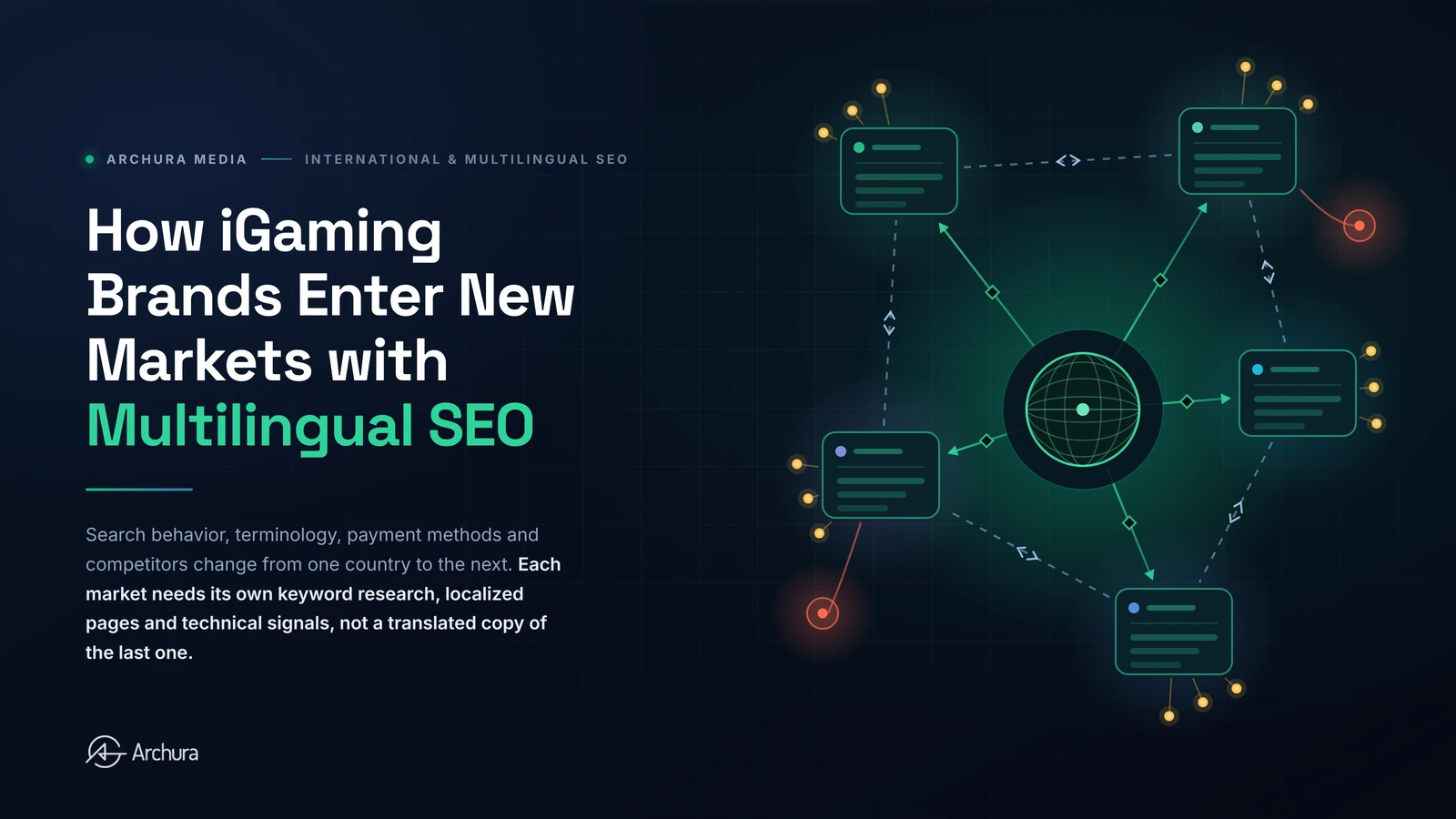
Entering a new iGaming market is not simply a translation project. Search behavior, terminology, payment preferences, regulations, competitors and even the way players describe casino or sportsbook products can change from one country to another.
A page that ranks well in English may perform poorly when translated word for word into German, Spanish, Turkish or Portuguese. Multilingual SEO works when each market is treated as its own search environment, while the technical structure makes it clear which page belongs to which audience.
Why Multilingual SEO Matters in iGaming
iGaming is unusually sensitive to localization because search intent is strongly commercial and market-specific. Players search for local bonuses, payment methods, licenses, apps, withdrawal information, game providers and branded terms. Affiliates also compete aggressively for the same queries.
If the operator launches only a translated homepage, affiliates and local competitors can occupy the long-tail searches that drive registrations and first-time deposits. A strong international SEO strategy therefore needs localized keyword research, content, technical signals and ongoing market monitoring.
1. Research Each Market Separately
Do not build the new market strategy by translating the keyword list from your existing country. Start fresh. Search volume, phrasing and commercial intent can differ even between countries that share the same language.
- Research casino, sportsbook, bonus, app, payment and branded queries in the local language.
- Review which affiliates and operators dominate the local SERPs.
- Identify country-specific payment methods, sports, game categories and trust signals.
- Map local terminology to the correct landing pages before content production starts.
The objective is not to translate keywords. It is to understand how players in that market actually search.
2. Localize Content Instead of Translating It
Literal translation often produces content that is technically correct but commercially weak. Localization adapts the offer, language and page structure to the market.
For example, a bonus page may need different payment information, currency, responsible gaming references, legal wording, sports examples and FAQs. Even calls to action can need adjustment because the most natural language for registration or depositing varies by market.
Keep each page primarily in one language. Google determines page language from visible content, so mixing large sections of several languages on one URL can make the experience less clear for both users and search engines.
3. Give Every Locale Its Own URL
Separate URLs make international sites easier to crawl, index and manage. For a global .com domain, subdirectories are usually a practical structure because they keep authority under one domain while creating clear market sections.
- example.com/en-gb/
- example.com/de-de/
- example.com/es-es/
- example.com/pt-br/
Country-code domains can also work, but they require more operational and SEO effort because each domain needs its own authority and maintenance. Whichever model you choose, keep the structure consistent and avoid serving different language content from the same URL based only on IP or browser settings.
4. Implement Hreflang Correctly
Hreflang helps Google understand equivalent pages created for different languages or regions. It is particularly important when you have similar versions such as English for the UK and English for another market.
Every localized page should reference the relevant alternate versions, and those references should be reciprocal. Use valid language-region codes where needed and consider an x-default version for users who do not match one of your targeted locales.
Hreflang is not a replacement for localization or canonicals. Each localized page should normally be self-canonical when it is intended to rank independently in that market.
5. Build Market-Specific Landing Pages
Do not stop at the homepage. The pages closest to conversion usually need the strongest localization.
- Welcome bonus and promotion pages
- Casino and sportsbook product pages
- Payment and withdrawal guides
- App download and login pages
- License, trust and responsible gaming information
- Game provider, sport and event landing pages
- Local FAQ and customer support content
These pages should reflect local search demand and link clearly to one another. A strong localized architecture helps search engines understand the market section and gives players a more coherent path from search to registration.
6. Protect Your Brand in Every New Market
New markets often expose weaknesses in branded search. Affiliates may already rank for your brand plus terms such as bonus, review, login, app or withdrawal before your official localized pages gain visibility.
Monitor branded SERPs by country and language from launch. Build official pages around high-intent brand queries and make sure offers, app links, payment information and trust content are current. Brand protection should be part of market entry, not something added after traffic starts leaking.
7. Localize Internal Links and Technical Signals
International SEO can fail even when the copy is strong. Navigation, breadcrumbs, sitemaps, canonicals and internal links need to support the same market structure.
- Keep local navigation inside the relevant language or country section.
- Include indexable localized URLs in XML sitemaps.
- Check canonicals after deployments and CMS changes.
- Avoid broken hreflang clusters or links to redirected URLs.
- Make language and region switching available through crawlable links.
Multilingual iGaming SEO Expansion Checklist
Area | What to Localize or Check | Why It Matters |
Keyword research | Queries, terminology, intent and competitors | Search behavior changes by market |
Content | Offers, currency, payments, FAQs and trust signals | Translation alone may not match local intent |
URL structure | Dedicated language or region URLs | Creates clear crawlable market sections |
Hreflang | Alternate language/region references | Helps match users with the right locale |
Technical SEO | Canonicals, sitemaps, redirects and internal links | Prevents conflicting localization signals |
Brand protection | Brand + bonus, review, login and app SERPs | Limits affiliate and competitor leakage |
Measurement | Rankings, CTR, registrations and FTDs by market | Shows whether visibility creates commercial value |
8. Measure Performance by Market, Not Globally
International expansion can look successful at site level while one market is underperforming. Segment SEO reporting by country, language and landing-page group.
Track organic impressions, clicks, CTR, non-brand rankings, branded visibility, registrations, FTDs and conversion rate. Also monitor which affiliates and competitors appear repeatedly around your most valuable queries. The goal is not simply to generate more international traffic; it is to acquire qualified players efficiently in each market.
Common Multilingual SEO Mistakes to Avoid
- Publishing machine-translated pages without local review or market adaptation.
- Using one URL that changes content automatically based on IP or browser language.
- Sending every localized page to the global homepage with canonical tags.
- Launching a market without local keyword research or branded SERP monitoring.
- Translating content but leaving navigation, metadata or internal links in the original language.
- Treating markets that share a language as if search behavior is identical.
Final Takeaway
Multilingual SEO for iGaming is market expansion through search, not translation at scale. Each country needs its own keyword research, localized content, technical signals and measurement framework.
Build separate crawlable URLs, implement hreflang accurately, localize the pages closest to conversion and monitor branded visibility from day one. When the technical setup and local search strategy work together, operators can enter new markets with stronger visibility, better player journeys and less dependence on third parties to capture demand.
FAQ
What is multilingual SEO in iGaming?
+Multilingual SEO is the process of optimizing an iGaming website for users searching in different languages and markets. It combines local keyword research, localized content, dedicated URLs, hreflang, technical SEO and market-specific measurement.
Should iGaming brands use subfolders or separate country domains?
+Both can work. Subfolders on a global domain are often easier to maintain and share authority, while country-code domains provide a strong country signal but require more independent SEO investment.
Is translating existing casino content enough for international SEO?
+Usually not. Search terminology, offers, payment methods, regulations and player expectations vary by market. Content should be localized around local intent rather than translated word for word.
What does hreflang do?
+Hreflang tells Google about equivalent language or regional versions of a page so it can better match searchers with the appropriate locale.
How should iGaming brands measure international SEO?
+Track visibility and commercial outcomes by market, including impressions, clicks, CTR, rankings, registrations, first-time deposits and organic conversion rate.